If people turn to Claude or ChatGPT to get their job done, and those tools get more capable, will they still need your product? Will they still need ours?
All product builders are battling with this, in some cases more than others. If content building is part of your product, just like it is for us at Beefree, this question is existential. So, how does your tool stay relevant? How do we stay relevant?
This is what’s keeping me up at night, and I want to share the framework we landed on to try to answer some of these tough questions. I think it applies well beyond us.
Your UI is no longer the only place to optimize
For most of the last decade, product strategy assumed a user's journey begins the moment they open your application: invite them in with a seamless, often free, first step; wow them with a great interface and a delightful experience; and everything downstream follows. I don't think that holds anymore.
The user experience itself is becoming assisted — not by a human colleague, but by AI that shows up wherever it's useful, and people adopt it the moment it's genuinely convenient. In practice, that means workflows that jump around: I might brainstorm a campaign in Claude, hand a draft to a tool like RGE Studio to actually build it, grab an image from another assistant, and bounce elsewhere before I'm done.
Integrations between products have been there for a long time, but here we’re talking about something different. It’s not about moving data, or importing and exporting assets. This is about executing tasks without using the user interface that was created for that task execution.
That should worry anyone whose product's value has mostly lived in the interface. If a job can be done just as well from outside your tool and there's no real depth underneath your UI, you're exposed, and pretending otherwise doesn't reduce the business risk.
The Dual-Surface Framework: Optimize the surface you own and the one you don’t
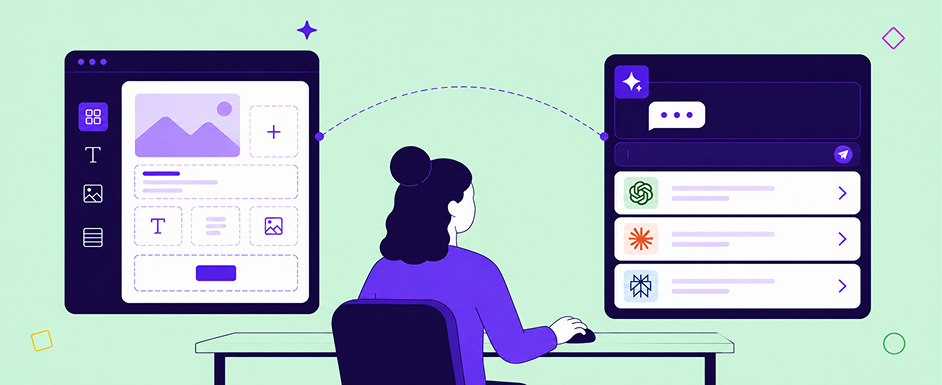
If work increasingly starts outside your product and ends somewhere inside it, you have to build for both parts of the journey. That's the core of what I call the dual-surface approach: treat the surface you own (your interface, the experience once someone arrives) and the surface you don't own (the AI tools and workflows where people already spend their time) as equal citizens, not competing priorities.
This only works as an and. Get the owned surface right and ignore the cross-tool perspective, and people simply won't find you from where they're already working. Get integrations to AI tools right and ignore the owned surface, and there's nothing to keep users once they arrive, and you're one connector away from being replaced by whoever builds a better one.
Durable products need to win on both fronts at once.
What this looks like for us at Beefree
We're investing in both surfaces in parallel.
When it comes to optimizing the cross-tool experience, we’re putting a laser focus on understanding where and how marketers turn to AI assistants to get a job done. We’re thinking deeply about how we can expose key Beefree functionality inside everyone’s favorite AI tools. And we are also providing direct pathways to bring users from their AI tool of choice into our product when continuing the workflow inside our visual builders simply makes more sense.
Inside our products:
- An outstanding editor experience for humans who want to apply granular modifications
- Features that help people stay in control: brand guardrails, approvals + reviews, QA checks
- Helpful, built-in AI tools for all the scenarios in which the content editing experience itself gets better with a smart assistant
If you’re a product builder who’s building on top of Beefree SDK, our MCP Server already gives you the option to connect key editor functionality to any AI agent.
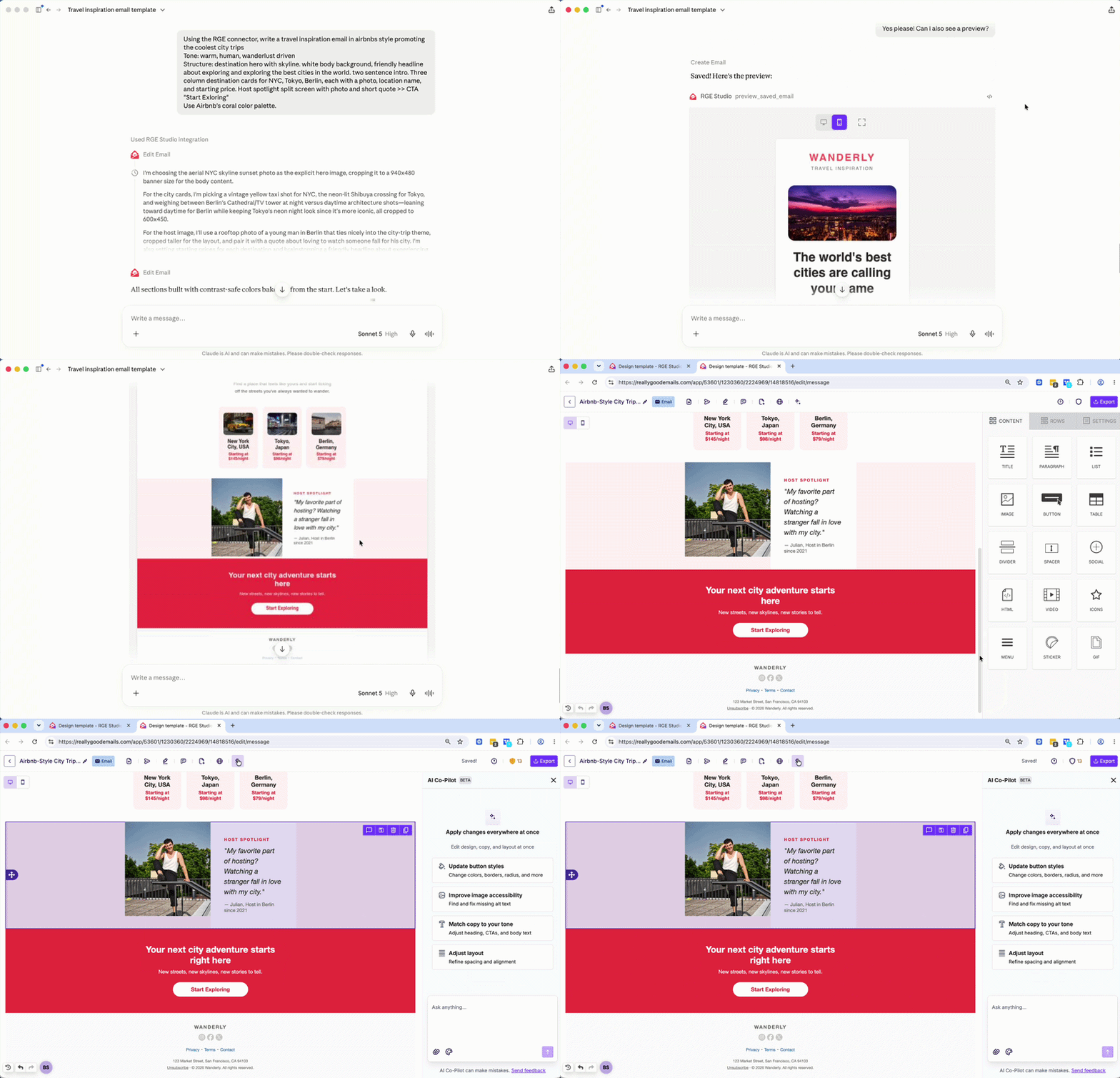
If you’re using Beefree SDK, we give you the tools to succeed on both fronts, allowing you to meet your users’ needs wherever they’re working.
The data behind our decisions
Part of our business focuses directly on marketers. Our Really Good Emails brand speaks to hundreds of thousands of lifecycle email professionals, through the Really Good Emails inspiration gallery, newsletters, events, and RGE Studio, an email production suite used by ~40,000 folks every month.
Really Good Emails is not only a fantastic part of our business. It’s also where we learn, first-hand. The approach that I mentioned above isn’t just based on a hunch: we surveyed over 800 people to get their opinions on all things email. 37% of people surveyed said that chasing down stakeholders for reviews and approvals is the most painful part of the process, even more so than data segmentation. So, RGE Studio offers in-app commenting, reviews, and approvals to make this process more seamless without taking the human out of the review process. This way, even if AI is used in the creation process, ultimately it’s a human looking at the end result and signing off that it’s on brand and good to go - or flagging when it’s not.
When these same people were asked how AI could become a more practical part of their workflow, 33% said having the confidence that outputs are accurate and safe to send. So, we built QA tools right into the builder, which check for things like poor color contrast, missing links, etc. And upcoming brand guardrails ensure that AI-generated content matches your users’ brand standards from the first pass.
25% also want AI that’s integrated directly into their existing workflow, aka the meeting them where they’re already working part of the dual-surface framework.
We’re listening and learning from these professionals. We are also getting a tremendous amount of feedback from the other ~450,000 people that use our tools in 1,100+ other applications that have embedded Beefree SDK. Combined, it’s a ton of content builders. They are all changing the way they work.
Navigating these changes is not easy. When it comes to the content building part of your product, you can count on us as a partner in figuring out how to best adapt to this rapidly changing world.
How we see the role of AI
I don’t want to ignore the elephant in the room. The sentiment around AI is often not positive, and there are good reasons for it. We believe in human-centered AI, the principle of creating AI that amplifies and doesn’t displace human abilities.
Beefree was born over 10 years ago to help people create better digital content. We believe that AI might help, but we are trying not to be naive about it. We understand that there are real choices to make, and we are doing our best to make them based on a few, clear principles.
We’ve summed them up in our AI Manifesto, which you can find here.
I’d love to hear what you think
If you're building a product and wrestling with the same existential questions that you found at the very start of this piece, I'd genuinely like to hear how you're approaching things. Do you agree? Do you think I got it wrong?
If content building is part of what your product offers, and you are considering using Beefree SDK - or maybe you are already one of our customers - then I’d love to know if our product direction matches your roadmap. Reach out to me on LinkedIn.
We are all exploring. We are all building for a future that’s hard to describe, and we want to make sure we’re meeting the needs of content builders now and in the future.
.png)
.png)

.png)

.png)
